Search This Blog

Showing posts with label sustainability. Show all posts

Saturday, May 14, 2011

Drylands Competition

Image from Drylands Competition.  All Rights Reserved.
A very interesting new competition has been announced this month by the California Architectural Foundation, in partnership with the Arid Lands Institute at Woodbury University and the AIACC Academy for Emerging Professionals.  The competition is is the 2011-2012 William Turnbull Competition: Drylands Design: An Open Ideas Competition for Retrofitting the American West.  The competition asks design teams to generate progressive proposals for creative alternatives for the American West in the form of new architecture or community design prototypes. The competition features a great jury of architects and landscape architects, and final proposals are due in December.  More information is on the website, and part of the competition brief is provided below.

The Challenge

Water scarcity is both the history and the future of the American west. Re-thinking water use, particularly in the face of climate change, will be central to the region’s survival. The work exceeds the grasp of a single discipline, and touches all dimensions of the way people live and work. Sustaining the US West in the face of water scarcity and hydrologic variability brought on by climate change will require strategic architectures, infrastructures, and urbanisms that promote adaptation and resilience. Drylands Design seeks innovation in architecture, urban design, landscape architecture, regional planning, and infrastructure design that addresses water supply, water quality, water access, water treatment, and the water/energy nexus. Drylands Design seeks integrative proposals from multidisciplinary design teams that anticipate science and policy perspectives as necessary dimensions of intelligent design response, and exploit beauty as an instrument of resilience and adaptation.

Competition Objectives + Priorities

The purpose of Drylands Design is to generate a portfolio of long term design strategies for the arid and semi-arid west’s water-scarce future. Proposals must recognize and address:

The Water-Energy Nexus
The relationship between water, energy use, and heat-trapping greenhouse gas emissions is intertwined and self-limiting; uncoupling water’s capture, treatment, distribution, and use from energy-intensive delivery systems is critical to a new western drylands design.

Scarcity + Variability
The twin effects of climate change on the American west’s hydrologic cycle are expected to be scarcity (prolonged drought periods and diminished snowpack) and variability (increased intensity of flood events). Design for variability will replace engineering for stationarity.

Localized Resources
Rain water, storm water and single-use municipal supplies, currently treated as waste or flood hazard, form the largest “undeveloped” sector of western water. Converting local liabilities to assets will offset dependence on carbon-intensive imports.

Social Equity
Recognizing that no built environment achieves true vitality without social equity, Drylands Design seeks proposals that actively benefit low- and middle-income communities, urban and rural. More specifically, Drylands Design seeks proposals that promote an active and participatory civic engagement by citizen-users.

Thus, Drylands Design seeks responsive, variable, localized, and low-carbon alternatives to energy-intensive, 20th-century centralized water engineering solutions. Drylands Design seeks a portfolio of strategies for the west that actively remediate the environmental sterility, economic monocultures, and cultural lethargy induced by the West’s dependence on an obsolete engineering paradigm. Drylands Design seeks proposals that tactically promote a place-specific built environment of both ecological and cultural vitality.
Site – Beyond the Hundredth Meridian
Drylands Design seeks proposals for the arid and semi-arid regions of the US West, using John Wesley Powell’s historic, and imprecise, designation—the 100th meridian—as its starting line. The 100th meridian, as Powell pointed out in his 1878 Report on the Lands of Arid Region, is the approximate demarcation line corresponding to a radical shift in US hydrology. Simply put, it is, more or less, where humid East ends and the arid West begins. All proposals must be sited in the United States, west of the 100th meridian.

Design proposals may be for a real or speculative project, for one or more real sites, and must be as yet BE unbuilt by Spring 2012. All design proposals must be sited conceptually within three scales: the local, the regional, and the global.
Local Specificity
All design proposals are required to be sited within a specific location in the U.S. arid or semi-arid west. Locally, even hyper-locally, site-specific design is required.

Regional Relevance
All design proposals are required to identify the ‘typicality’ of particular site conditions, and address or speculate on scalability and replicability of design strategies to other comparable sites throughout the west.

Global Context
All design proposals are required to speculate on scalability and replicability to drylands in other parts of the world. If sprawl is arguably the West’s most enduring global export, could intelligent drylands design be its next?

Although this competition is not site specific, a site in Fresno, California may be used for the project if the team desires. Click here for information regarding this site.

Architectural Proposals With the above water issues in mind, design a building on a specific drylands site in the American West as defined in “Site” above. Architectural proposals may include, but are not limited to:

  • Single Family or Multi Family Dwellings
  • Commercial/Industrial Complexes
  • Mixed Use or Hybrid programs
  • Civic/Educational Buildings
  • Community Design Proposals
    With the above water issues in mind, develop a community design proposal on a specific drylands site or region in the American West as defined in “Site” above. Community design proposals may include, but are not limited to:

  • Civic infrastructures
  • Urban Landscapes
  • Regional Planning
  • Friday, April 22, 2011

    Happy Earth Day!

    Happy Earth Day!  In celebration of making today, and every day, a celebration of our biosphere, here are a few links to making live in Los Angeles more earth-friendly:
    Sustainable Living
    Green LA 
    Be Waterwise


    Biking
    Los Angeles County Bicycle Coalition
    Bike LA

    Urban Greening
    TreePeople
    Million Trees LA
    LA Guerilla Gardening
    Los Angeles Community Garden Council


    Advocacy

    Friends of the LA River
    Friends of Ballona Wetland

    Saturday, February 12, 2011

    National Tree Benefit Calculator

    Speaking of the importance of well-planned and supported street trees, The National Tree Benefit Calculator is an excellent new website from Casey Trees and Davey Tree Expert Co. that allows you to calculate the benefits of a street tree in your neighborhood.  Just type in your zip code and select an extensive list of tree species, and you can determine how much the tree is, or could be, adding to your property value, air quality, stormwater management, and utility savings.  Even better, the result also points out how much more benefit the tree is if nurtured and allowed to grow to even larger diameter, and provides a conceptual summary of how a tree can impact site performance.  The website is only in BETA-testing right now, but this is going to be a great outreach tool for engaging the public,and potential clients, in the value of planting, and maintaining, trees.  Below is a bit more about the assessment tool:
    The Tree Benefit Calculator allows anyone to calculate a first-order approximation of the benefits individual street-side trees provide. This tool is based on i-Tree’s street tree assessment tool called STRATUM. With minimal inputs of location, species and tree size, users will get an understanding of the environmental and economic value trees provide on an annual basis.

    The Tree Benefit Calculator is intended to be simple and accessible. As such, this tool should be considered a starting point for understanding trees’ value in the community rather than a scientific accounting of precise values. For more detailed information on urban and community forest assessments, visit the i-Tree website.

    Credits:
    The National Tree Benefit Calculator was conceived and developed by Casey Trees and Davey Tree Expert Co.

    This tool is powered by i-Tree; the data generating the results comes from the i-Tree Tools CD ROM: http://www.itreetools.org/

    Significant text and graphical content was originally published by the USDA Forest Service’s Center for Urban Forest Research through their Tree Guide series of publications. Credit should be given to authors of these publications.

    Facts about personal carbon production based on driving and flying courtesy of Conservation International

    For questions about this tool, contact Mike Alonzo (Casey Trees) or Scott Maco (Davey Tree Expert Co.)

    Wednesday, January 5, 2011

    LID Passes! (At least another round)

    In rounding out unfinished business from 2010, a nice bit of news about the City Council passing a LID ordinance for Los Angeles before the calendar year ran out.  (Or, at least an important directive to prepare a full, legal ordinance to vote on and officially enact sometime in early 2011.)  LA Creek Freak has the details:
    At its final meeting of the year, yesterday, Friday December 17th 2010, the Los Angeles City Council passed “LID”  Low Impact Development. You can read some earlier background at Creek Freak and elsewhere, but basically it means that, in the city of Los Angeles, new development (and substantial redevelopment) will need will need to be more sustainable in regards to rainwater. Buildings, landscapes, parking lots, etc. will need to slow, detain and store and/or infiltrate water on-site, instead of speeding it into storm drains, creeks, rivers, and the sea.

    This took a while. L.A. Creek Freak started reporting on the city of L.A. efforts in September 2009, attended a workshop in October 2009, and reported on the Public Works Board passing LID  in January 2010. Plenty more excellent coverage is available at Heal the Bay’s Mark Gold’s Spouting Off.


    It also took a great deal of effort from the city’s Board of Public Works and the Bureau of Sanitation’s Watershed Protection Division – in conjunction with city environmentalists, especially Heal the Bay, TreePeople, and Green L.A. Coalition. Some developers and building industry folks have opposed LID because it can make make some construction more expensive. Ultimately, though there had been opposition at earlier hearings, LID passed council with no elected’s nor public speaker’s opposition. It slipped in quietly via the consent calendar.

    There are still a few steps before the mass proliferation of creek-friendly developments, too – the motion that passed directs the City Attorney to prepare the regulations, then those get adopted and take effect… stay tuned.

    . . . .
    Pretty exciting to recognize not only that environmental advocacy and education worked to pass the measure, but effectively worked (in conjunction with the support of environmentally engaged council members) to sway the entire City Council.   This bodes well for official passing of the final, legal measure once the City Attorney prepares it for the City Council.  Congrats to all of supporters of the measure, and the tireless organizations who helped move it forward.  The watershed, and I, thank you.  

    Sunday, November 21, 2010

    Paper or plastic? How about just Paper

    La-me-plastic-bags
    Image from LA Times. All Rights Reserved.
    This past Tuesday, Los Angeles County officially banned all plastic carryout bags from use in unincorporated portions of the County.  The vote marks a big environmental victory for LA County, with the potential to severely reduce the amount of plastics polluting our waterways and urban landscapes.  Admittedly, the ban remains imperfect, particularly because it only affects unincorporated portions of the County, but with more than 1.1 million residents being affected, the scale of the ban is still quite significant.   The LA Times has great coverage and recap of the vote, including comments from its detractors, and comparisons of the ban to similar efforts in California and beyond.  Below is an except:
    . . . .

    The ban, which will cover nearly 1.1 million residents countywide, is to the point: “No store shall provide to any customer a plastic carryout bag.” An exception would be made for plastic bags that are used to hold fruit, vegetables or raw meat in order to prevent contamination with other grocery items.

    If grocers choose to offer paper bags, they must sell them for 10 cents each, according to the ordinance. The revenue will be retained by the stores to purchase the paper bags and educate customers about the law.


    “Plastic bags are a pollutant. They pollute the urban landscape. They are what we call in our county urban tumbleweed,” Supervisor Zev Yaroslavsky said.


    Mark Gold, president of the Santa Monica environmental group Heal the Bay, said previous county efforts to promote recycling of plastic bags at grocery stores was a failure.


    “You cannot recycle your way out of the plastic bag problem,” Gold said. “The cost of convenience can no longer be at the expense of the environment.”


    The measure is a significant win for environmental groups, which suffered a major defeat in Sacramento at the end of August with the failure of the state Senate to pass a sweeping plastic bag ban that won the support of the state Assembly and Gov. Arnold Schwarzenegger amid heavy and costly lobbying by plastic bag manufacturers.


    But the ban could cause confusion. The action by the Board of Supervisors only covers the unincorporated areas of L.A. County, covering some neighborhoods like Altadena, Valencia and Rowland Heights, but doesn't cover 88 cities in L.A. County. City councils could adopt a similar ordinance.

    Supervisor Michael D. Antonovich  raised the prospect that small mom-and-pop shops could suffer financially because they won’t be able to buy paper and reusable bags in great volume, and could force low-income people to buy bags to pick up pet waste or carry their lunch.


    “At a time of economic uncertainty, with a large number of businesses leaving our state and community this would not be an appropriate time ... to impose this additional regulation,” Antonovich said.


    Opponents of the ban told the supervisors that a legal challenge to the ban is still a possibility.


    With the Tuesday vote, L.A. County’s measure is more stringent than similar bans adopted elsewhere in California, Gold said.  


    San Francisco’s ban, which passed three years ago, is less restrictive because it still permits grocers to offer bioplastic bags made from corn starch, which are imperfect because they also do not degrade in the ocean, Gold said. Bans in San Francisco and Malibu also do not add a surcharge on paper bags, Gold said, which does not give consumers an incentive to switch to reusable cloth bags.


    . . . .

    Friday, November 12, 2010

    Westside Subway Route Approved

    Proposed Route for Purple Line Extension.  Image from LA Times.  All Rights Reserved.
    The future of public transit in Los Angeles took a meaningful, if not controversial step forward a few weeks ago when a general route for extending the Purple Line to the westside was approved.  Despite protests from Beverly Hills residents, and concerns about the likelihood of finding funding the project, the step marks an important opportunity for cultivating an effective mass transit system for all of LA. Here is the announcement from the LA Times:
    Development of a long-awaited subway link from downtown Los Angeles to the Westside took a giant leap Thursday when county transportation officials selected a general route from the Wilshire-Western station to the veterans hospital in Westwood.

    The decision by board members of the Los Angeles County Metropolitan Transportation Authority sets the stage for the trickier business of going block by block to establish the precise path and determine where to place stations.

    Construction is set to begin in 2013 after a final environmental impact review.


    MTA staff had recommended the 9 1/2-mile route to the veterans' hospital because of higher ridership projections. The estimated cost of that option is $5.15 billion.


    Four other options were under consideration by the board, which included Mayor Antonio Villaraigosa, who has stressed the need for a Westside "subway to the sea" throughout his tenure as mayor.


    Those included a nine-mile extension from the Wilshire-Western station to Westwood-UCLA; a 12-mile alignment to the beach in Santa Monica; a route to the veterans hospital campus plus a spur to West Hollywood; and a 12-mile link to Santa Monica plus the West Hollywood spur. The estimated costs of the projects ranged from $4.2 billion to $9 billion.


    Also under consideration Thursday was a $1.37-billion regional connector through downtown Los Angeles that would allow light-rail users to travel across the county without time-consuming transfers.
    The westside has certainly been their own worst enemy in gaining access to rail (or perhaps preventing access to the westside by others via rail), but this proposed route, along with the Phase II extension of the Expo Line underway in Culver City slated to terminate in Santa Monica, could dramatically improve the opportunities for LA residents to effectively move throughout the city without having to get into a car.  Great coverage of the decision can be found at the LA Times and Metro Source Blog, and below is an image from the Metro Source Blog highlighting the potential rail linkages to the Westside. 

    Map of Proposed Purple Line Extension and Expo Phase II alignment.  Image from Metro's Source Blog.  All Rights Reserved.

    Arid Lands Lecture Series

    So this post is a day late and a buck short for last night's lecture featuring Aziza Chaouni and Liat Margolis, but the Arid Lands Institute at Woodbury University is featuring another excellent series of lectures on Thursdays this fall and winter.  The theme for the series is "Excavating Innovation: The History and Future of Drylands Design."  Recent lectures have covered such topics as the "Waters of Rome" and "Out of Water".  More information about upcoming lectures is listed below in their recent press release, and can also be found at aridlands.woodbury.edu/lectures.

    Excavating InnovationThe History and Future of Drylands Design
    Lecture Series: 2010_2011
    The human need for water has ordered landscapes, given rise to culture, and shaped architecture + urban form throughout history.

    Excavating Innovation: The History and Future of Drylands Design
     examines the role of water engineering in shaping public space and city form, by using arid and semi-arid sites in India, the Middle East, the Mediterranean, and the New World to explore how dryland water systems throughout history have formed and been formed by ritual, hygiene, gender, technology, governance, markets, and, perhaps above all, power.

    Excavating Innovation: The History and Future of Drylands Design brings together historians, urbanists, and contemporary designers to selectively excavate global historical case studies and reveal relevance to contemporary design practice.
    Katherine Rinne:  The Waters of Rome
    Thursday, October 7th, 2010


    Aziza Chaouni + Liat Margolis
    :  Out of Water

    Thursday, November 11th, 2010

    Morna Livingtson
    :  Steps to Water

    Thursday, November 18th, 2010 

    Nan Ellin, PhD:  
    Canalscape
    Thursday, January 27th, 2011

    Vinayak Bharne:  
    Urban Water Crisis/Perspectives from South Asia
    Thursday, February 10th, 2011

    Monday, October 25, 2010

    Riverside County Gets World's Largest Solar Array

    The LA Times reported today that the Bureau of Land Management (BLM) has approved a proposed 7,000 acre solar project for Blythe, CA backed by Solar Millennium, a German-based corporation.  The 1 gigawatt installation would be the world's largest solar installation, at the same time effectively doubling the United State's entire solar production potential:
    What’s the sunny equivalent of “when it rains, it pours”? Because that’s what’s happening in Southern California, as yet another massive solar plant cleared the permitting process Monday.

    This time, it’s the Blythe Solar Power Plant, backed by German company Solar Millennium and planned for more than 7,000 acres in Riverside County. The project would be the largest solar installation in the world, doubling the amount of solar electricity the U.S. can produce.

    The Blythe installation is the sixth in recent months to be approved for public land. Several proposed solar plants have been fast-tracked through the permitting process as they race to meet the December deadline for federal stimulus funds. One of those, the Ivanpah Solar Electric Generating System, is breaking ground Wednesday near Primm, Nev.

    Winning final clearance to start construction from the Bureau of Land Management on Monday, after getting the go-ahead from California authorities last month, makes Blythe the first proposal of its kind to be approved for federal public land.

    The installation will deliver 1 gigawatt of power using parabolic trough technology. The process involves curved mirrors that gather the sun’s rays, heating liquid that creates steam to run generators.

    The multibillion-dollar Blythe project will consist of four separate, 250-megawatt sections that together would be able to power more than 300,000 average homes -– even up to 750,000 residences by some estimates.

    The groundbreaking should happen by the end of the year, Solar Millennium said. But first, the company is in “advanced discussions” with the Department of Energy as it attempts to land $1.9 billion in government debt financing for the first two portions of the project, as several other solar projects have done.

    Construction is expected to create more than 1,000 direct jobs, as well as thousands more throughout the supply chain, the company said. Once built, the plant will support nearly 300 permanent jobs.

    The project, however, will have its share of impact on the environment. So, to mitigate any potential damage, regulators are requiring that Solar Millenium cough up funding to support more than 8,000 acres of habitat for native species such as the desert tortoise, the Western burrowing owl, the bighorn sheep and the Mojave fringe-toed lizard.
    Certainly the announcement is great news, but also sounds a note of caution.  The plant is a great opportunity for the US to deploy solar technology in a large-scale capacity, and will hopefully promote desperately needed economic gains within the region via a green technology. But, the sheer scale of the plant also underscores the impacts all energy production technologies, whether traditionally oriented or renewable, impose upon the surrounding environment.  Each imposes a true physical cost to the landscape that may vary in scope, but does not waver in its lasting impacts. It will be interesting to see what mitigation measures are implemented, and how successful they are in offsetting impacts to habitat in highly sensitive landscapes.  Above all, I guess we can consider the  experiment known as the solar-era officially underway in Southern California, and hope that the promise of renewable energy rings true. 

    Saturday, October 23, 2010

    Long Beach Turf Rebate

    Image from LA Times.  All Rights Reserved.
    News flash - rebates and outreach work.  Or, at least they do in Long Beach, whose recent turf reduction rebate program has been a rousing success.  As Emily Green from the LA Times reported a few weeks ago, the first two rounds of the program, which offers a $2.50 per square foot rebate for lawn converted to low-water garden, are complete, and have produced a number of compelling and interesting outdoor spaces for residents of Long Beach:
    It stands to reason that clean-ocean advocates would appreciate how important it is to check the stream of pesticide and fertilizer pollution that runs into the Pacific from lawn-sprinkler overflow. But what has dazzled everyone familiar with the Beautiful Long Beach Lawn-to-Garden Incentive Program is how citizens of this beach city have been so ready to do their part. The first day that the Long Beach Water Department began accepting applications, conservation specialist Joyce Barkley said, “They were gone in 45 minutes.”
    Hopefully these great results will not only further such programs but pay dividends in making LA a more sustainable city.  Some great photos and stories of homeowners taking advantage of the rebate can be found at Green's column.

    Saturday, September 4, 2010

    Green Walls - A Counterpoint

    As you can probably guess, I am an interested party in the green wall movement, and intrigued by how they might be useful in Los Angeles from a sustainable and aesthetic perspective.  So, this week provided a couple of interesting perspectives to consider whether green walls make sense in Los Angeles, and if so, in what form.  The first was a blog post on the ASLA Sustainable Design and Development Blog by April Philips highlighting some her own experiments in the performance of green walls in California. Although informal, the experiments provided an anecdotal account of which systems worked best for her.  The second, was a pointed critique of the green wall fad by LA Times columnist Emily Green.  Green cast a strong, skeptical eye and asked some legitimate questions about whether green walls really make sense in an arid environment. Below is a long excerpt:
    . . . My own feeling about vertical gardens in Southern California is that they are a plant fetishist’s tool for hastening climate change. Take a look at the Culver City party venue called SmogShoppe,[photos shown on this blog before] owned by the folks selling a vertical garden system called Woolly Pockets. Succulents such as sedum and senecio that are so hardy in the ground need constant irrigation to cope with heat and wind after being suspended in felt pockets against SmogShoppe’s hot walls. The concrete wall behind the bagged-and-hung garden is wet with runoff from an automated drip system. The sacks are calcified with irrigation scale. Even in an open-air setting, get close and there is a whiff of mold. It’s hard to imagine a less savory or more whimsically destructive system for a region in a water crisis.

    Recently, L.A. has been gripped by a challenge from the Woolly Pocket manufacturer to put its planting bags on fences in hundreds of schools. I dread seeing abandoned, tattered pocket remnants fluttering from chain link.

    School gardens should connect kids with Earth. As for other settings, the idea of using plants to animate walls -- be they in civic arenas, offices or homes -- is intriguing. But if we truly want to accomplish this in a way that speaks to the dry majesty of our region, then the right approach is to leave out the irrigation and work solely with appropriate building materials to create suitable planting habitat -- then seed it. Bring back the lovely old dry stone walls of yore. If you really want to marvel at the majesty of plant life, witness a wild buckwheat flowering from an abandoned stone wall in the foothills.

    Proponents praise vertical gardens for beauty. This charm is irrefutable. Just as Turner became mesmerized in Paris, pedestrians stop short before the SmogShoppe. Yet enthusiasts lapse into nonsense when extolling ecological virtues to do with heat insulation and repositories for gray water. If you want relief from the sun, hang an awning, build a porch or plant a shade tree. Gray water is still water, and wasting it is still a socially disastrous idea in the dry West. Far better to put gray water in the ground, where it will be protected from evaporation and remain available to plants.

    Finally, there is the energy profile. Roughly a quarter of the state’s energy goes to transporting water; of that, the majority is spent getting it from the Bay Area and the Colorado River to Southern California. Once that water gets here, the region needs a better way to green and cool buildings that doesn’t involve dinky pockets of captive flora.
    Overall, Green provides a biting commentary, and while I don't necessarily agree with every assessment, she underscores some critical questions that all designers should be asking themselves, especially in the West.  In particular:

    1.) What are the water and energy impacts of each potential system you might use?
    In the West, if not everywhere, you have to consider these impacts as paramount concerns.  Many of the companies are investigating the impact of their components, and taking strides to improve the manufacturing cycle, but does the installation and operation of that system present an unnecessary water or energy profile?  Does it require too much water to keep the plants alive?  If so, is it really worth it?  Which leads to perhaps the underlying issue all designers must consider before specifying a green wall system . . .

    2.)  Does this system accomplish something that might otherwise be unattainable? 
    At its core, this question is really asking, does this system potentially provide a benefit or trade-off that might justify its use of precious resources?  The benefits of green wall systems are varied, but the primary benefit in my eyes is the opportunity to vegetate a space or surface that could not be vegetated in a traditional way, potentially introducing benefits such as visual relief, cooling, and habitat to places where limited open space has prevented traditional vegetation strategies.  As such, green walls in densely urban areas present an opportunity to bring back a piece of nature and greenery in places heavily impacted by development.   The bigger question remaining in the West, though, is whether our development conditions really warrant a green wall intervention.  As dense as cities like Los Angeles are, the by-product of low-profile, sprawling development is that there is a lot of space waiting to be reconfigured and replanted.  Designers need to evaluate each individual project and condition to determine whether a system is extending the benefits of traditional planting strategies by adding an additional niche for vegetation to thrive within, or is it simply providing an architectural folly.  Are you using a metal frame to do the job of a shrub or tree, (and if so, why are you reinventing the wheel?), or, are you creating a healthy foothold for vegetation where previously it was not considered possible? 

    Other potential considerations include cost, both initial and long-term.  And in this arena, I disagree with Green somewhat.  While I wholeheartedly support Green's point that school gardening programs should be focused on reconnecting kids to the soil (and that ground-plane, soil-based gardening has a much larger positive ecological impact than any green wall system.), Woolly Pocket's program offers a cost-effective option for cash-strapped agencies who may not be able to afford the demolition costs (both financial and physical loss of space) for a traditional school garden.  It offers a foot in the door, so to speak, or, a vertical equivalent of a container garden to begin reengaging kids with the natural world.  It is not perfect or ideal, but it just may accomplish something that was otherwise not achievable. 

    As any good skeptic and critic does, Green tries to remove the seductive draw of a fad and highlights the core issues that should inform the selection of any component in the landscape, green wall system or not.  Selection needs to be based on competent, informed judgement and critical evaluation.  April Philips references the same issues in her blog post.  Noting a recent LinkedIn discussion on the issue, she quotes Dean Hill, ASLA, CGP from greenscreen:
     “As designers, WE are responsible for matching the plant selection, irrigation design and maintenance commitments within the right system and intended use. In addition, I think that it is our responsibility to manage the client’s expectations. Interested clients might see pretty pictures and think that they’ve got to have one, but we need to take the opportunities to educate them so that their expectations will be met, especially with green wall systems (facade and living).”
    Using and adapting green wall systems in the West is an ongoing process that requires us to consider our larger impacts, and use green wall systems because they are right for a particular situation, not simply because they are popular.  However, like all good design, effective selection of green wall components can create installations that are contextually sensitive, beautiful, and functionally adept.

    Monday, July 5, 2010

    Bike Corrals at Santa Monica Public Library

    (Image from Evan G. on Flickr.  All Rights Reserved.)
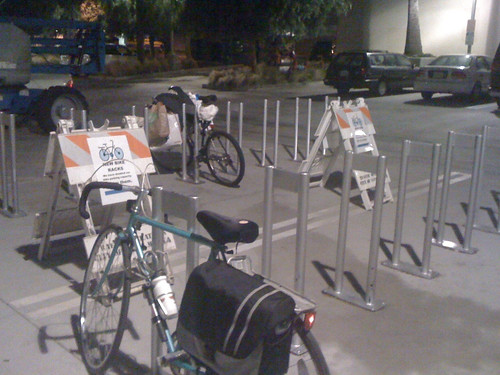
    Stumbled upon this photostream while on LAStreetsblog.  It showcases the new bike corral installed at the Santa Monica Public Library, replacing two parking spots with 18 parking spaces for bikes.  Nice, simple action to encourage biking even more in already bike friendly Santa Monica. 

    Sunday, June 27, 2010

    Community Based Water-Harvesting Update

    View of planter circa May 9th (top) and circa June 25th (below).
    I posted about a small, raised planter / stormwater management cell a local group installed in a parkway last month, and here are some updated photos of it.  The vegetation continues to grow in, adding a spark of green to the street along with the promise of some vegetables (Tomatoes, Kale, and more) by the end of summer. 
     View of planter circa May 9th (left) and June 25th (right)

    Monday, May 31, 2010

    SSI - Pilot Projects Selected


    The Sustainable Sites Initiative has selected over 150 Pilot Projects for testing out the new SSI rating system.  California has a total of  21 projects represented, with 6 in the Los Angeles Region.  The projects represent a broad cross-section of development types, and final results of the Pilot Project studies should conclude in June 2012.  Below are summaries of the 6 Los Angeles Area projects from the SSI website:
    Annenberg Project at Lower Point Vicente
    Rancho Palos Verdes, California

    Project Type:
    Institutional/Educational
    Project Team:
    Annenberg Foundation, Melendrez, KPFF Consulting Engineers, Swatt / Miers Architects, Ganahl Construction Corporation
    Description:
    The vision for this education and family destination is to create an area that connects the community to the ocean and the land, providing education, interpretative facilities, and recreational opportunities, linking the site to the trails at the Vicente Bluffs Reserve and beyond. Careful consideration is being given to the potential impact of the improvements on the surrounding environment, especially to neighboring homes.

    Bioswales and Landscaping at Glen Oaks/Sunland Boulevards
    Los Angeles, California

    Project Type:
    Transportation corridors/Streetscape
    Project Team:
    Hollywood Beautification Team, City of Los Angeles Department of Public Works
    Description:
    This streetscape project will install bioswales, remove asphalt from medians, and install trees and plantings at the intersection of Glen Oaks and Sunland Boulevards in the San Fernando Valley. Storm water flooding will be mitigated and water will be captured and added to the water table for later use. The project is also associated with an ongoing job training program. 


    Headwaters Corner at Calabasas
    Calabasas, California

    Project Type:
    Institutional/Educational
    Project Team:
    Mountains Restoration Trust
    Description:
    Headwaters Corner is a 12-acre interpretive center in the critical urban/wildland interface of Los Angeles and the Santa Monica Mountains National Recreation area. The goal of the project is to demonstrate to people how to be a positive factor in the ecosystem. The site contains a perennial headwater stream to the Los Angeles River, and representative examples of 5 plant communities: riparian, wetland, oak woodland, coastal sage scrub and grassland. Two single family structures are adapted for education and administration purposes with the intent to use them in green demonstrations. 

    Magnolia Power Plant
    Burbank, California

    Project Type:
    Industrial
    Project Team:
    Burbank Water and Power; AHBE Landscape Architects
    Description:
    The Magnolia Power Plant, operated by Burbank Water and Power is an exemplary model in sustainable design from its high-efficiency heat recovery steam generator down to the shared bikes throughout the plant's campus for employee transportation. Examples also include the plant's power generation which uses recycled water for steam, landscape areas use recycled water for irrigation which are managed by climate-based irrigation controllers and are planted with native, and/or drought tolerant species and a vegetated green roof. Currently in the design phase is a public green street demonstration project that is planned along the western edge of the campus as a means to communicate innovative stormwater management technologies to the city and adjacent community.  

    Sunnylands

    Rancho Mirage, California

    Project Type:
    Residential
    Project Team:
    Annenberg Foundation Trust at Sunnylands, Ganahl Construction, The Cultural Landscape
    Description:
    This project will improve the sustainability of the landscape at this 200-acre estate that hosts world leaders and dignitaries and is open to the public for tours. There will be a significant reduction in grassy areas, more native plants, an updated irrigation system, multiple steps for water conservation, and more. Adaptations and enhancements to the care and maintenance will demonstrate the protection of a landmark site, while bringing it closer to sustainability.

    The Annenberg Center at Sunnylands

    Rancho Mirage, California

    Project Type:
    Institutional/Educational
    Project Team:
    Annenberg Foundation Trust at Sunnylands, Ganahl Construction, the Office of James Burnett
    Description:
    A new garden is being constructed at The Annenberg Center at Sunnylands. The garden design is based on Impressionist and Post-Impressionist art with repetition and massing of desert plants suited to the natural climatic conditions of the site. A highly efficient, fine-tuned irrigation system will minimize water requirements, while greenwaste will be recycled and reused. The importance of sustainability is threaded throughout the larger Center and will continue through the garden.  

    Sunday, May 9, 2010

    Community-based Water Harvesting

    My neighborhood just got a welcome, new addition.  A local community group recently built a raised planter / stormwater management cell in a parkway to help control runoff from a nearby parking lot.  The cell incorporates broken concrete slabs to frame the planter and provides raised beds planted with vegetables and flowers.  While the cell is definitely a small, primitive intervention compared to many of the well-publicized, pilot projects we see in Portland and beyond, the project underscores for me the power of simple, community-based efforts for reworking our urban landscapes in a more sustainable fashion. Something as simple as some concrete, small grade changes and soil can help reduce runoff and increase planting area along a street.  Can't wait to see how well the cell works in a rain event, and the maturation of the plantings. 

    Saturday, May 8, 2010

    Vote for Santa Monica Demonstration Gardens

    (Project Site - from City of Santa Monica.  All Rights Reserved)
    The City of Santa Monica is sponsoring a design competition for three demonstration sustainable gardens at 3200 Airport Ave, and wants your input.  Nine finalist designs have been selected from 27 entries, and now it is up to the public to vote for their favorite designs.  The gardens will be built side by side, and will provide examples of sustainable gardening along with design information, referrals and technical information to the public.  Voting closes on May 31st.  More information is available on the LA Times Home and Garden Blog and you can view the finalists, read more about the projects and vote here

    Thursday, April 15, 2010

    Casa Dominguez - Affordable Housings Goes Green

    (image from LA Times. All Rights Reserved)
    The LA Times had a great profile of Casa Dominguez, an affordable housing development in Compton that is poised to become the first LEED Platinum affordable housing project.  Hopefully the project will serve as an example for how to bring sustainability and green design to people often left behind by the marketplace, and underscore the power design has to change people's outlook.  As the article points out:
    Geneva Mason, 23, who is transitioning out of foster care and is 7 months pregnant, began talking about her new lifestyle in the building by making a confession:

    "I'm not going to lie. I was once a litterbug," she said. "But ever since I moved into the green environment, I'm more about picking up litter. Once you go through the gates … it's like a little town of its own — lovely, fresh. I'm excited about raising my child here."

    Conservation Efforts Work

    Despite a former vice president's belief to the contrary, conservation efforts work quite well.  Case in point,  Los Angeles.  The LA Department of Water and Power reported on Tuesday that "despite a population growth of 1 million people, the residents and businesses of Los Angeles are using the same amount of water now that was used in 1979."  DWP noted that the average residential customer has cut water use by 29.2 percent the past 9 months following the institution of mandatory conservation limits.
     
    "Our customers' ability to reach 1970's water use levels at a time when our city's population has grown by more than a million people is truly remarkable," DWP Board President Lee Kanon Alpert said. "Angelenos understand the urgency for water conservation.
    . . .
    "Their actions show it, and we thank them for understanding the severity of the ongoing water crisis in our state."
    . . .
    During the nine months that these restrictions have been in place, Angelenos have cut their water use by nearly 30 billion gallons -- enough to serve 231,000 households for a year, according to the DWP.  As a result, the DWP is slated to purchase 16 percent less water from the Metropolitan Water District than it had planned to, during the current fiscal year.
    . . .
    The amount of water used last February was the lowest recorded water use during any February in 32 years, according to the DWP, which serves about 680,000 water customer accounts in Los Angeles.
    It also marked the 31st consecutive month of reduced water use by the DWP's single-family residential customers. During that period, they collectively slashed consumption by about 30 percent, the DWP said.

    "In a time when water resources are scarce throughout the state, Los Angeles is taking the lead and setting an example on how to conserve water and maintain a sustainable water supply," said James McDaniel, DWP's senior assistant general manager for its water system.

    "The more we can rely on our city's available water resources, the better prepared we are to get through this water crisis as a state," McDaniel added.

    Angelenos whose lawns are turning brown because of the water restrictions can take advantage of the DWP's turf removal program, which rebates customers $1 per square foot of lawn removed and replaced by drought- tolerant plants or permeable hardscape. The rebate limit is $2,000. (from NBC4-Los Angeles)

    Sunday, April 11, 2010

    Council District Nine Neighborhood City Hall

     View from roof garden of arrival courtyard, stormwater pond, and solar panels.
    As part of National Landscape Architecture Month, the SoCal ASLA Chapter hosted a lecture and tour at the new Los Angeles Council District Nine Neighborhood City Hall.  The lecture included a talk by Simon Pastucha from the City of Los Angeles Urban Design Department, and an introduction of the project by the designers and project sponsor, District 9 Councilmember Jan Perry.  Paul Murdoch Architects, Rana Creek, and Pamela Burton and Company designed the project, which offers an interesting approach to green urban infrastructure in the park poor, highly urban area of South Central Los Angeles.  The 37,000 acre site was envisioned as two things: first, a demonstration site for sustainable technologies for the surrounding community, and, second, as a new, safe open space for the community.  The resulting design incorporates a 7,000gallon underground cistern, a stormwater collection pond, green walls, parking lot bioswales, drought-tolerant plantings, solar panels, and a huge, accessible roof garden designed as a new community open space.  Open since January, the project has already been a huge success, and hosted a number of community events.  As Councilmember Perry noted, the site has provided a space for people of all ages to gather at night safely, and has also reintroduced a bit of nature into the highly urban environment.  Both squirrels and butterflies have been seen on the site, which most of us might consider seemingly common elements, but rare are features in District 9.  Great project, and great model for ways to retrofit our built environment.
    Stormwater management pond with rain chain
    View of the accessible roof garden.  A mix of succulents, grasses, and wildflowers fill the planters.  A strong scent of sage permeated the space when we visited.
    View of the parking lot and bioswales used to manage runoff. 

    Saturday, April 10, 2010

    Arid Lands Recap #2


    (Image from Fritz Haeg.  All Rights Reserved.)
    The Second Workshop in the Arid Lands Series was “Smart Landscapes: Yard, Driveway, Sidewalk, Street” and featured a talk by artist Fritz Haeg, architect Holly Harper, and landscape architect David Fletcher.  Fritz Haeg talked about his ongoing "Edible Estates" art project that has converted 8 lawns around the world into high-profile food producing gardens for the homeowners and residents.  Holly Harper discussed some of her work with the non-profit Northeast Trees which was founded by a landscape architect and installs urban green infrastructure in Los Angeles, including street trees and alternative stormwater infrastructure.  And David Fletcher discussed the different design strategies available for stormwater management, and presented some interesting case studies and conceptual work demonstrating how these tools can be applied to a site in a functional and aesthetic fashion.

    By far some of the best quotables came from Fritz Haeg, in part because his project is designed to be provocative.  However, Holly's talk provided a nice technical case study of how you can build in stormwater capacity into an existing street with 95% impermeability, and David provided a nice conceptual framework for designers to think about how stormwater management can be part of an aesthetic language that has cultural meaning and beauty beyond the purely technical innovation these new strategies represent.  Below are some of the interesting tidbits (recorded and or paraphrased to my best ability) that came out of the talk:

    “Lawn is the biggest crop in the United States (if you include our front yards in the equation)” - Fritz Haeg

    "I like to create landscapes that demand participation. You can't learn to grow food from the internet, you have to interact with people." - Fritz Haeg

    "People make decisions (about our built environment) that we are left with." - Fritz Haeg


    "Multifunctional design is like the difference between a regular knife that can cut things and a Swiss Army Knife that can still cut like a knife, but it also has all of these other capabilities." - David Fletcher

    Friday, April 9, 2010

    National Landscape Architecture Month

    It's April and that means it's National Landscape Architecture Month. The Southern California ASLA Chapter has a number of good events lined up for the month, including a tour this Saturday of the Council District 9 Neighborhood City Hall by Pamela Burton and Company that features a green roof, solar panels, and a graywater reuse system (see poster below).

    Other events include lectures by Mia Lehrer and Ken Smith, and tours of Vista Hermosa Park and Valley Crest Tree Nursery.  More information on all of the events is available at the Southern California ASLA webpage.